32 bags & quilts · 29 pads · 16 makers · ~$50–$795 · updated September 2026
The number on the bag is not the temperature you sleep at
A bag called a 20 is usually comfortable somewhere in the thirties, and the pad underneath decides whether it gets close. Every entry here leads with the lab figure where the maker publishes one, says plainly when they don’t, and shows the R-value the bag actually needs beneath it.
- Widest honesty gap
- 13 °FSea to Summit Spark 15label vs lab
- Best warmth per ounce
- 1.47 °F/ozTherm-a-Rest Vesper 20 Quiltbags & quilts
- Best R per ounce
- 0.47 R/ozNEMO Tensor Extreme Conditionspads
- Warmest pad
- R 8.8Exped Ultra 8RASTM tested
Everything we track
Sixty-one bags, quilts and pads on one sheet. Filter by the number that decides your night — the ISO comfort rating for a bag, the R-value for a pad — then tick up to three of the same kind to line their specs up.
Features
61 items found · page 1 of 3
Tick up to three of the same kind to compare them
Western Mountaineering
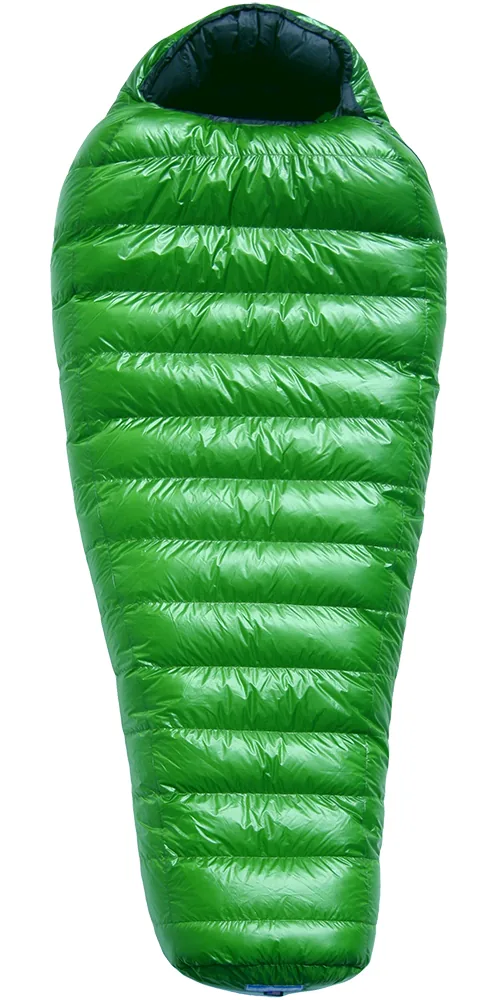
Western Mountaineering VersaLite 10
Ten degrees, six and a half inches of loft, twenty ounces of 850-fill down, and three inches more shoulder girth than the UltraLite — which is the point of it. The VersaLite is the bag for someone whose trips run from October frost to alpine summer and who would rather carry three extra ounces than own two bags. At 32 ounces it weighs less than plenty of 20-degree bags in this catalogue, and the girth means a puffy jacket can be worn inside it without crushing the loft.
Best for: One bag covering shoulder season and light winter
Full spec sheet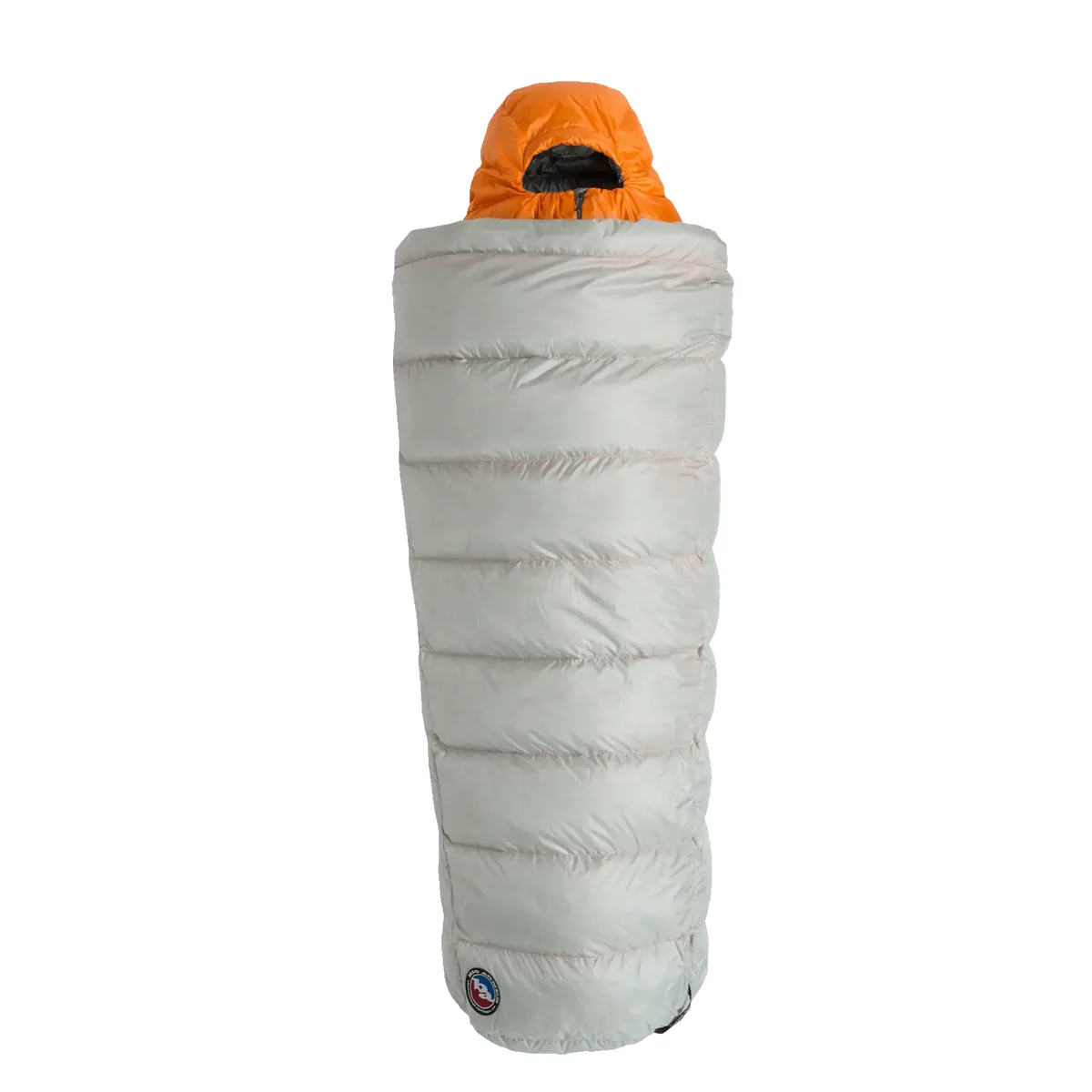
Big Agnes
Big Agnes Lost Ranger 3N1 15
Two bags that nest: an outer 15-degree shell and an inner lighter bag, usable separately for summer, together for winter, or as a single mid-weight bag in between. It is the most flexible sleep system in this catalogue and also the heaviest way to buy that flexibility — 44.5 ounces for the pair. For a family or a couple who camp from June through October and want one purchase to cover it, the argument holds. For a backpacker it does not.
Best for: One purchase covering summer through shoulder season
Full spec sheet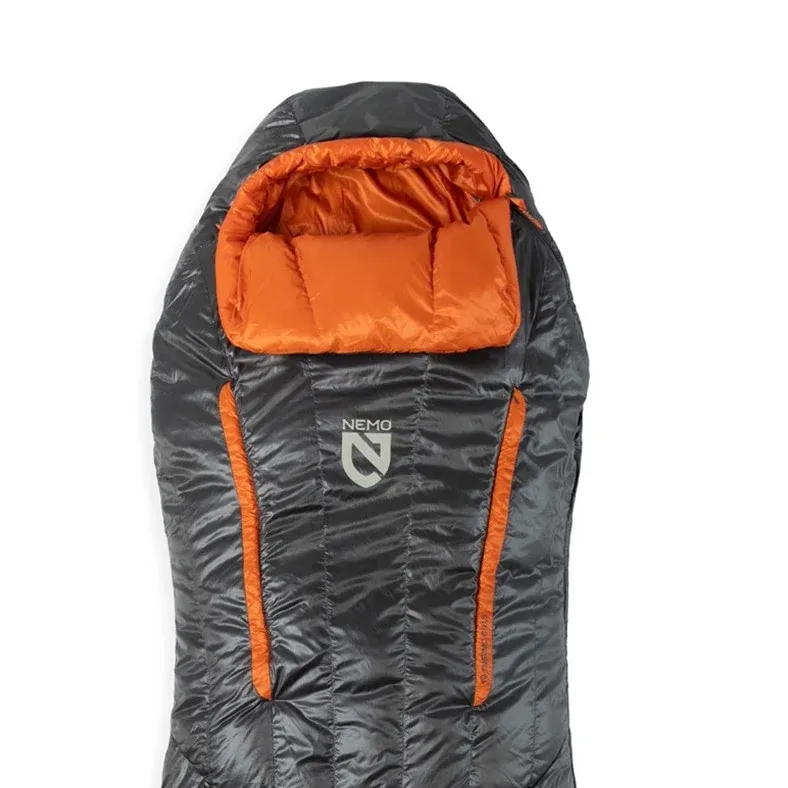
NEMO
NEMO Disco 15
The Spoon shape is NEMO's one genuinely original idea in sleeping bags: extra room cut in at the elbows and knees and taken back out at the shins, so a side sleeper can bend a leg without fighting the bag. If you have ever woken up wrapped in a mummy bag that rotated with you, this is the fix. The Disco is the 650-fill version — heavier and bulkier than the 800-fill Riff above it, and $100 cheaper. NEMO publishes an ISO lower limit of 16 °F but no comfort figure, which is the standard half-disclosure across this brand's line; assume comfort lands roughly ten degrees warmer.
Best for: Side sleepers who find mummy bags claustrophobic
Full spec sheet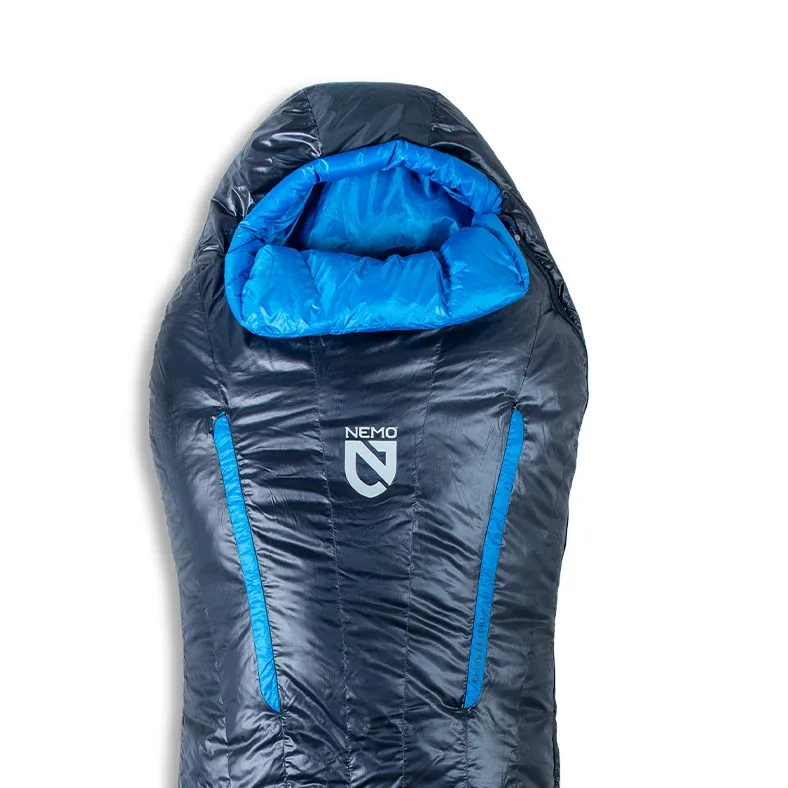
NEMO
NEMO Riff 15
The Disco's trimmer, more expensive sibling: the same Spoon silhouette and the same Thermo Gills in a narrower cut with 800-fill down instead of 650. That buys four ounces and half a litre of pack space for $100. Whether that is a good trade depends entirely on how far you are carrying it — for a weekend it is not, for a long trail it very much is.
Best for: Side sleepers going long enough that four ounces matters
Full spec sheet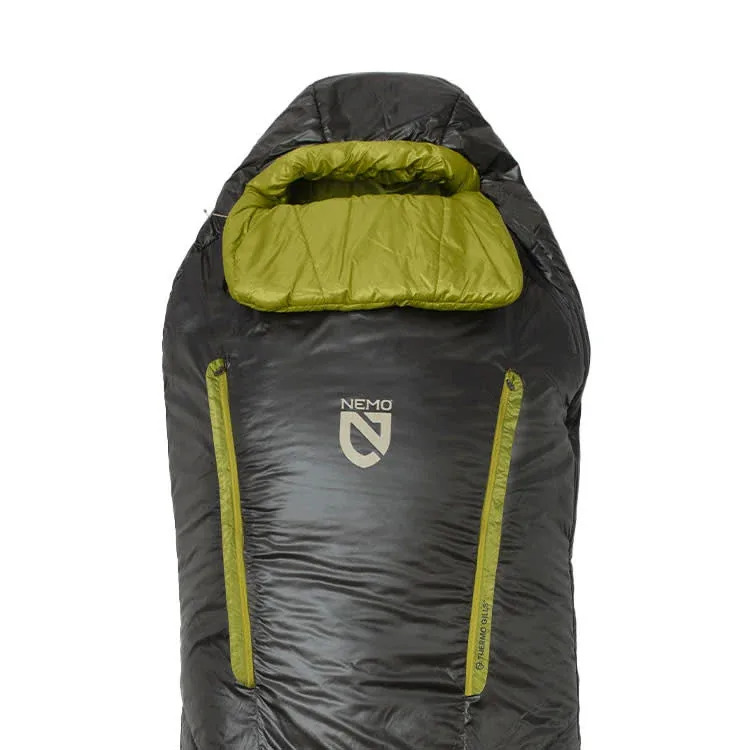
NEMO
NEMO Forte 20
The synthetic Spoon bag, and the right recommendation for anyone camping somewhere persistently damp — the Pacific Northwest, the Appalachians in spring, anywhere a down bag spends a week slowly losing loft. Zerofiber is made entirely from post-consumer recycled polyester, and it keeps insulating wet, which down does not. The cost is real: 53 ounces and 10.6 litres of pack space, roughly a quarter more weight and 60% more volume than the down Disco at a similar rating.
Best for: Wet-climate camping where down is the wrong insulation
Full spec sheet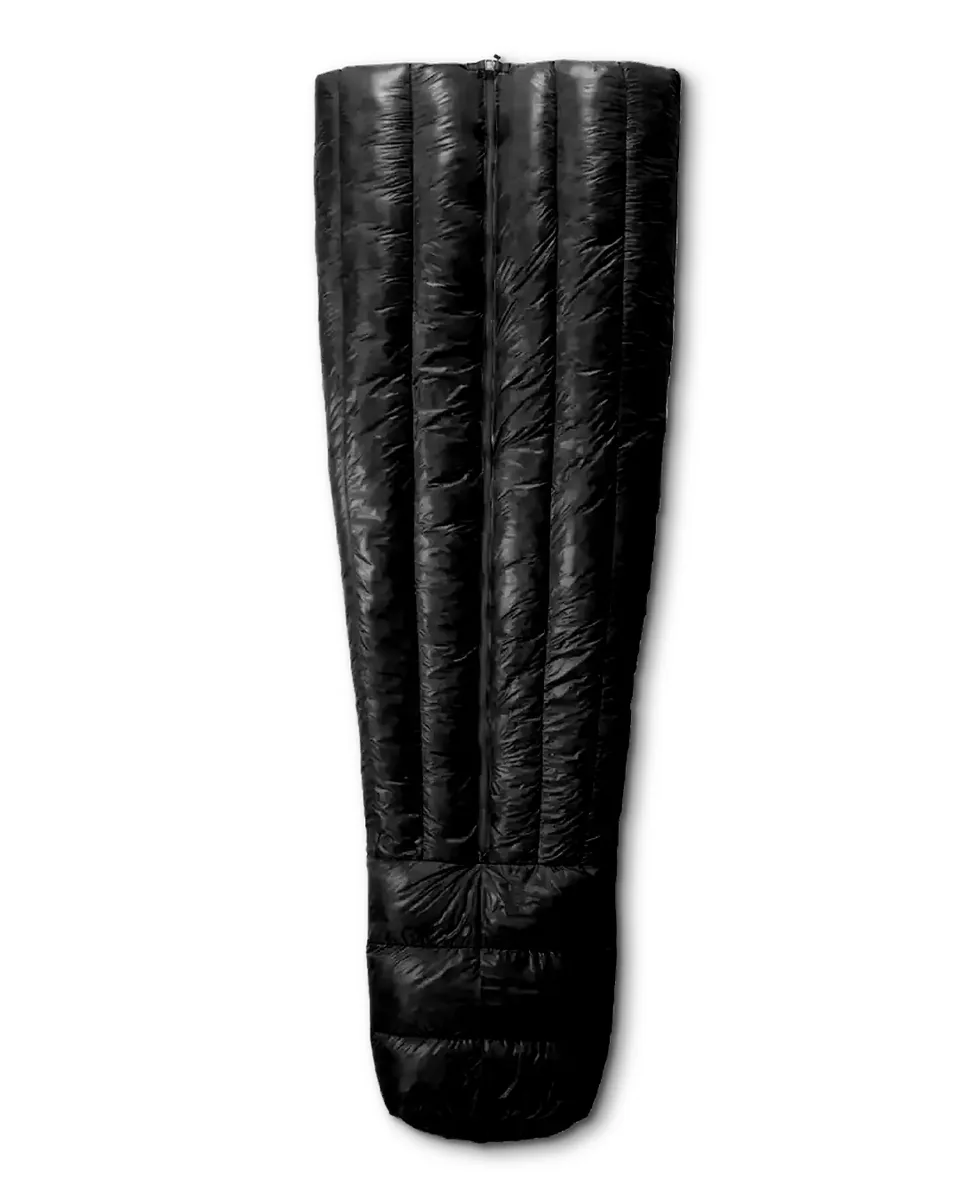
A sleeping bag with no zipper at all: a sewn tube with a hood, which is the lightest way to build a closed bag and the reason the Standard/Medium comes in at 18.8 ounces for a 20-degree rating. Zpacks publishes target loft (2.5 inches for the 20 °F version) and exact shell and down weights for every one of the twenty-one size combinations, which is more transparency about construction than anyone else in this catalogue offers — and no lab rating at all, which is less transparency about temperature. Getting in and out means going through the top, and the bag cannot be vented on a warm night.
Best for: Thru-hikers who want a hood without a quilt's drafts
Full spec sheet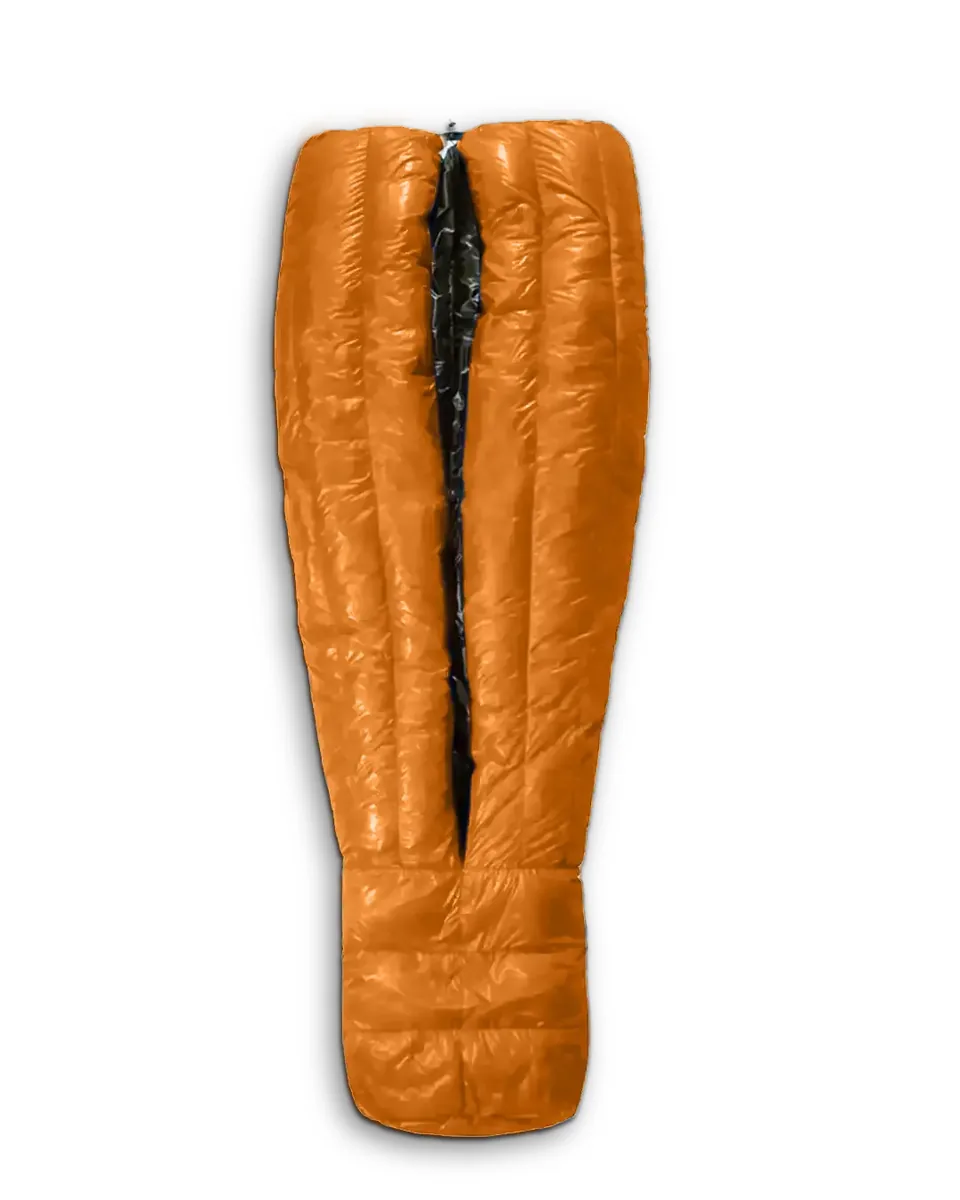
Zpacks
Zpacks Solo Quilt 20F
The Classic bag with the hood and the back panel removed — the same down weight, the same 900-fill, half an ounce lighter. That half-ounce difference is the most useful single data point on this whole site about what a hood actually costs, and the answer is: almost nothing, because the down that would be under your back has already been left out of the bag. What you are really choosing between is a hood and a draft-free back, versus the freedom to stick a leg out.
Best for: Side sleepers who move all night and want nothing pinning them
Full spec sheet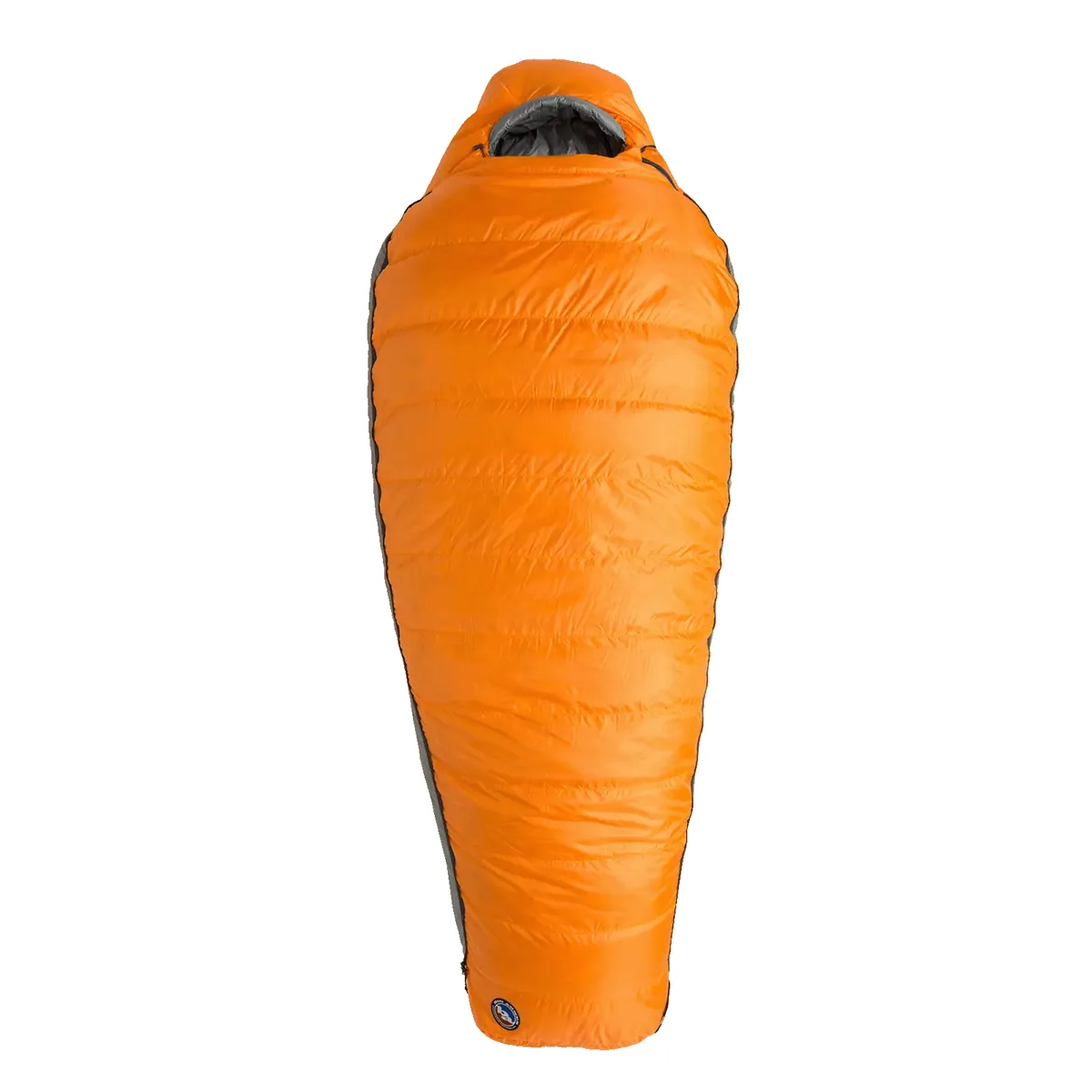
Big Agnes
Big Agnes Torchlight EXP 20
Two zippered expansion panels run from shoulder to footbox and add five inches of girth on each side — ten inches in total — which makes this the only bag here whose fit you can change after you have bought it. Zip them shut on a cold night and it is a normal mummy; open them on a warm one and it is closer to a semi-rectangular bag. That is a genuinely good answer to the problem that a bag tight enough to be warm is too tight to sleep in. The trade is 40 ounces and a manufacturer-only 20-degree rating with no lab figure behind it.
Best for: Sleepers who want a mummy some nights and room on others
Full spec sheet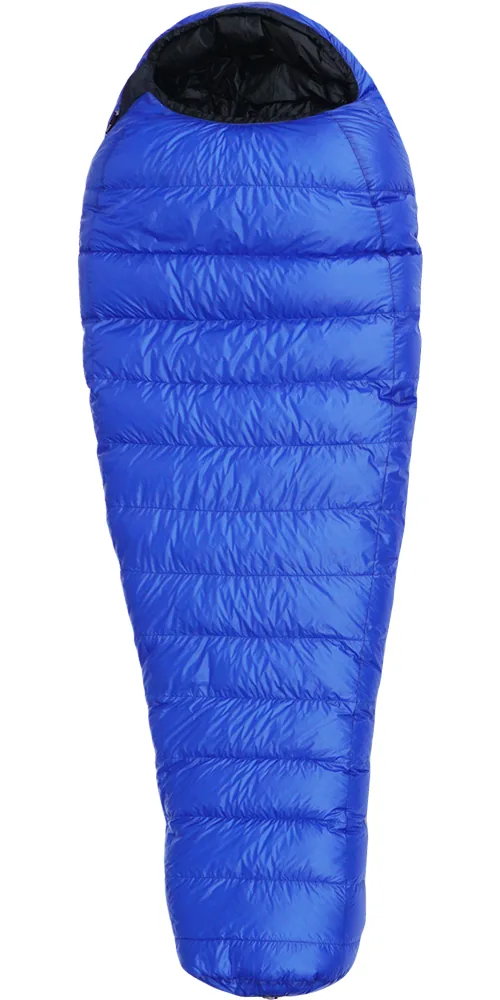
Western Mountaineering
Western Mountaineering UltraLite 20
Western Mountaineering has been building bags in San Jose for fifty years and has never published an EN or ISO rating for any of them — the 20 °F on the UltraLite is the company's own number, and its reputation rests on that number having been accurate for two generations of backpackers. What it does publish is the physics: 5.5 inches of measured loft, 16 ounces of 850-fill goose down, 59 inches of shoulder girth and a 12-denier shell, for a total of 29 ounces. Continuous horizontal baffles let you shake the down to the top on a cold night or to the sides on a warm one, which is a feature almost nobody else offers and which more than compensates for the missing zip vent.
Best for: Buyers who plan to own one bag for twenty years
Full spec sheet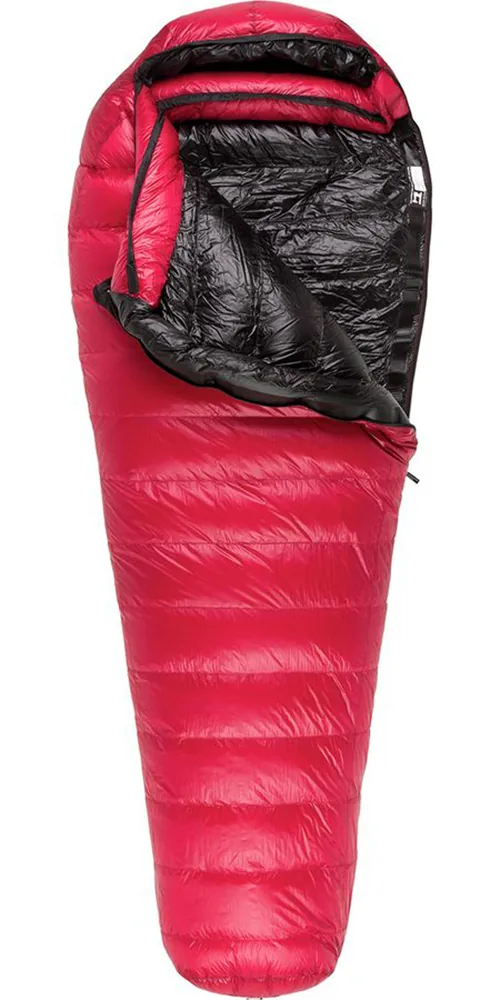
Western Mountaineering
Western Mountaineering AlpinLite 20
The UltraLite cut wider: same 20-degree rating, same 5.5 inches of loft, five more inches of shoulder girth and three more ounces of down to fill the extra space. Two ounces of total weight is the whole cost of the upgrade, and for anyone who has felt pinned in an UltraLite it is the obvious choice. The 7'0" length is the only bag in this catalogue that fits someone genuinely tall without compromise.
Best for: Broad-shouldered or very tall sleepers who want a proper down bag
Full spec sheet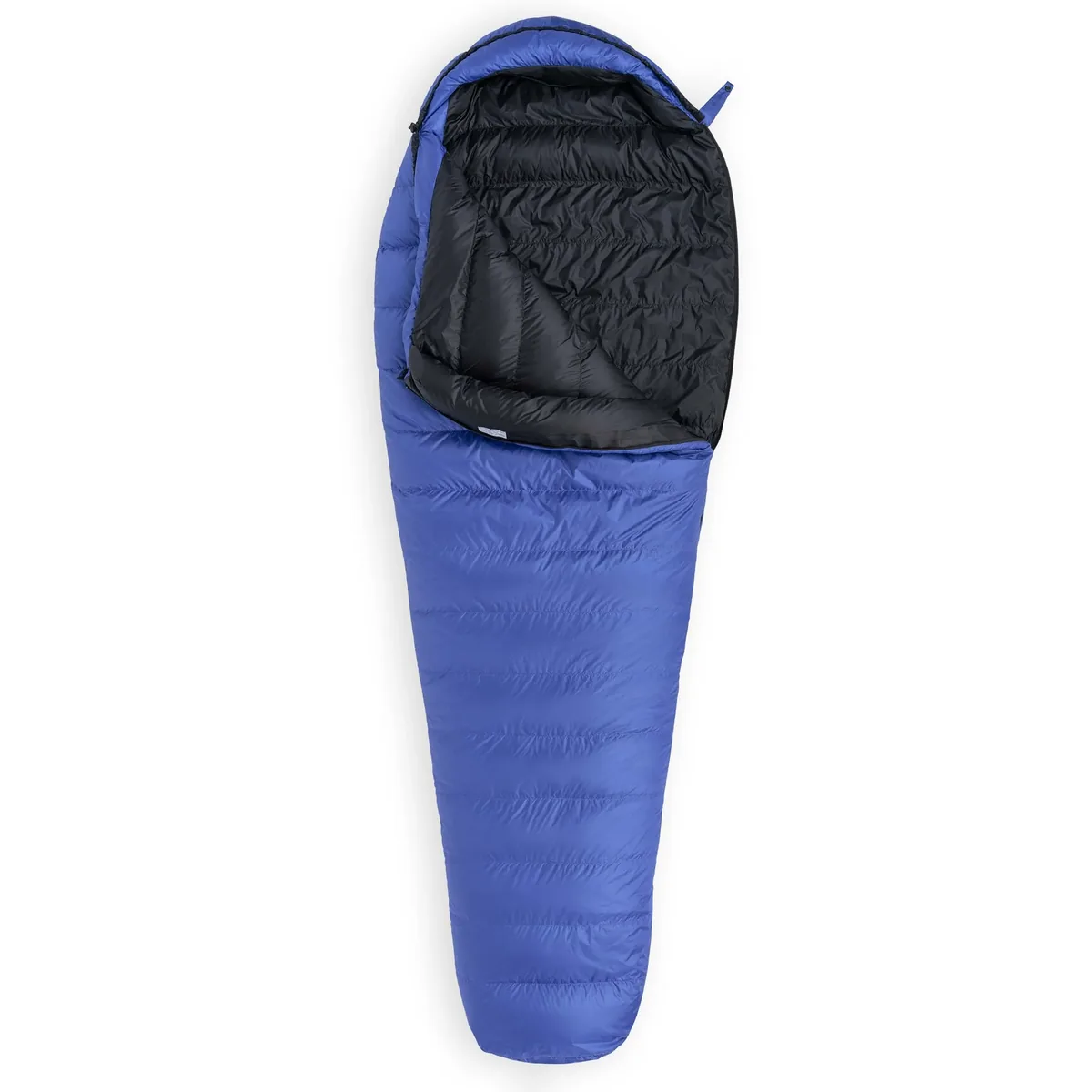
Feathered Friends
Feathered Friends Swallow YF 20
Feathered Friends sew every bag in Seattle and publish girth at four points — shoulder, elbow, hip and footbox — which tells you more about whether a bag will fit than any temperature rating can. The Swallow is their three-season workhorse: 900-fill-power Muscovy down, 16.8 ounces of it, in a 59-inch-shoulder mummy that weighs 29.2 ounces. Like Western Mountaineering they publish no ISO figure, and like Western Mountaineering they have a forty-year record that people buy on instead.
Best for: Three-season backpacking where fit matters as much as warmth
Full spec sheet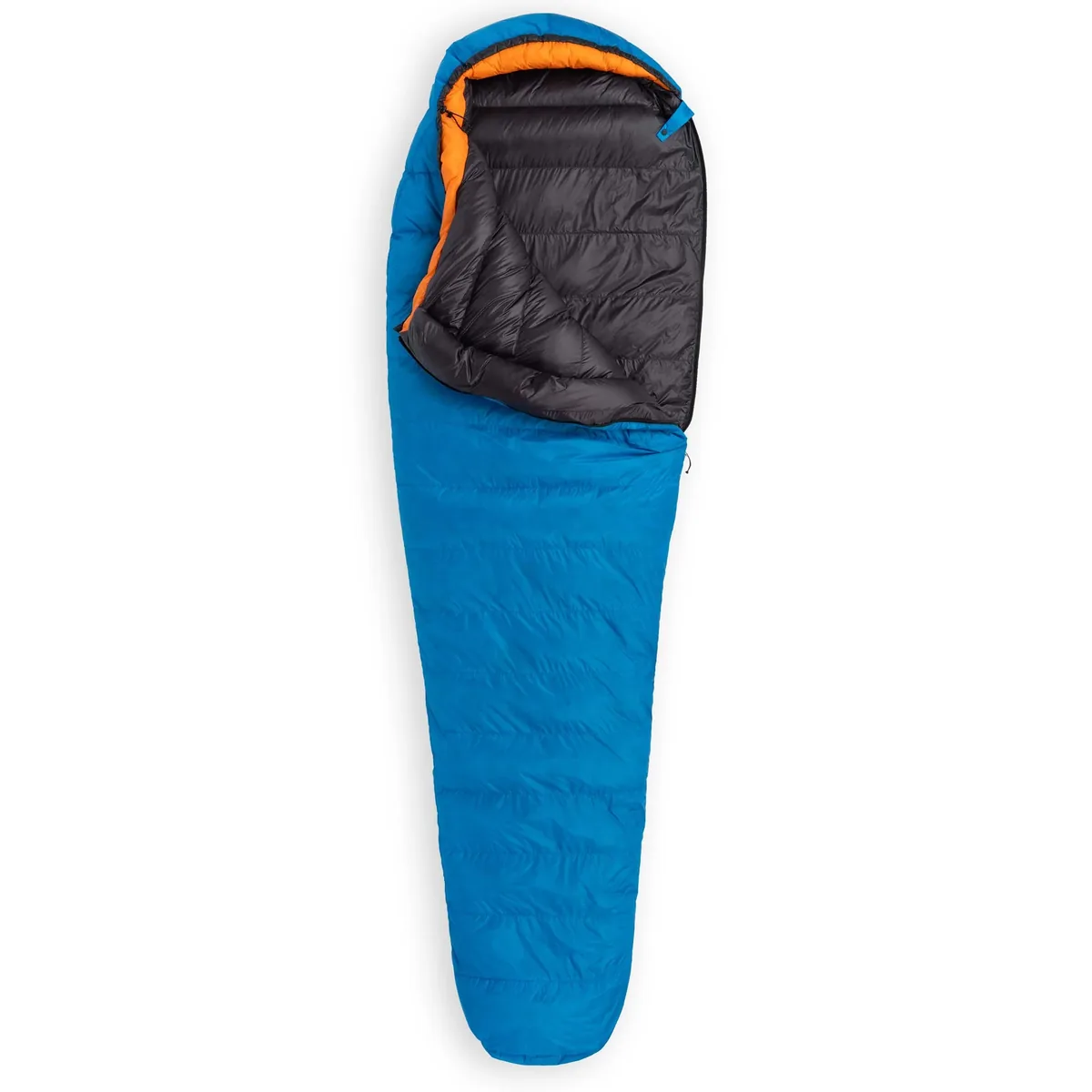
Feathered Friends
Feathered Friends Hummingbird UL 20
Twenty-three point nine ounces for a hooded, full-zip 20-degree bag with 950-fill down — the lightest bag of its kind in this catalogue by about five ounces. Feathered Friends gets there with a 7-denier-by-30-denier Pertex Quantum Pro shell, which is a waterproof-breathable fabric rather than a simple ripstop, and by trimming the shoulder girth to 57 inches. That last number is the thing to check before buying: this is a close-fitting bag, and a broad sleeper will compress the down against the shell and be cold in it.
Best for: Long trails where a hood is wanted but ounces decide
Full spec sheet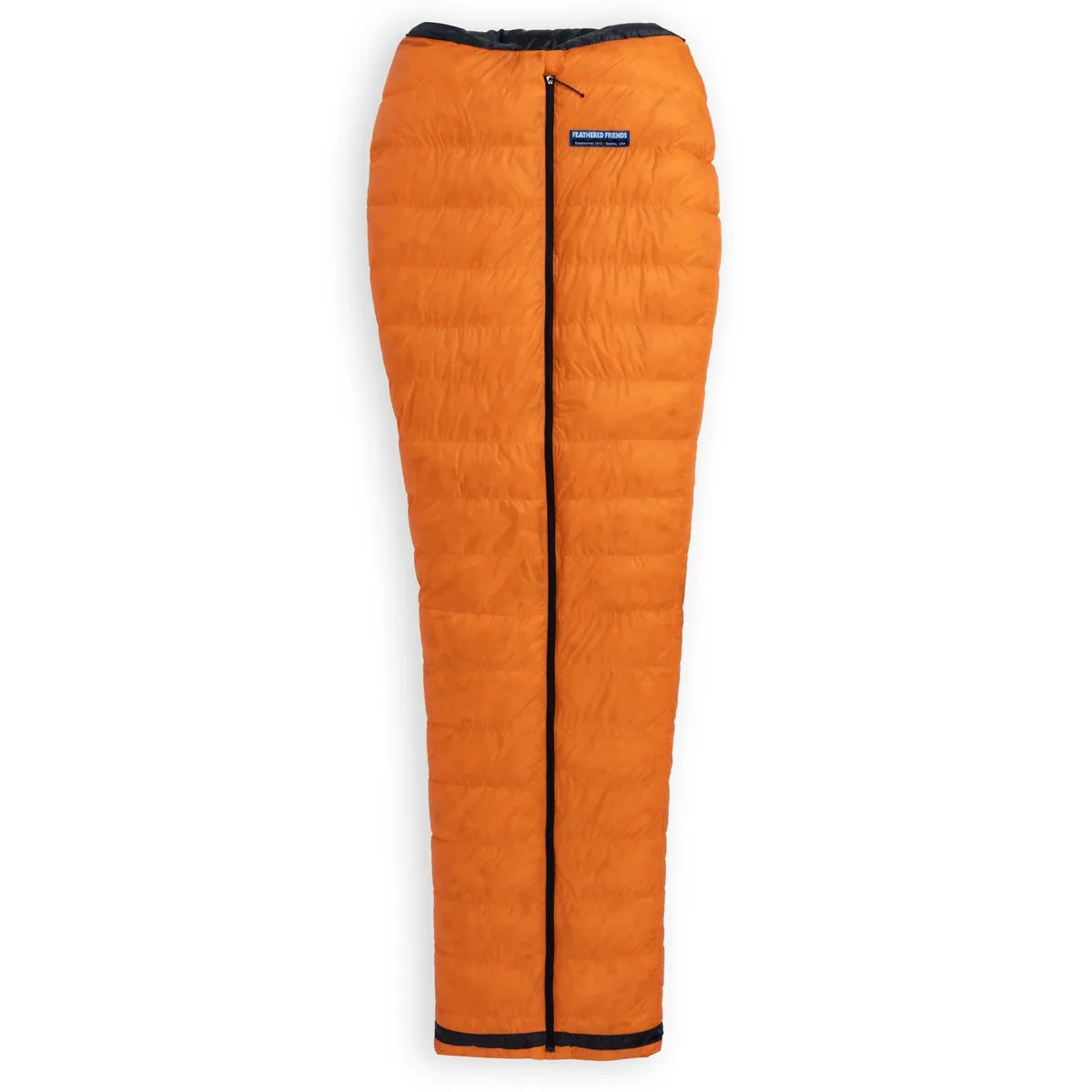
Feathered Friends
Feathered Friends Flicker UL 20 Quilt
The Flicker answers the quilt-versus-bag argument by refusing to pick: a full-length centre zip and a drawcord footbox mean it closes into a hoodless bag on a cold night, opens as a quilt on a mild one, and lies flat as a blanket in a hut. Because the zip runs down the middle rather than the side, the closure sits over your chest where you can reach it, and there are no pad straps to fight. Sixty-two inches of wrap width is generous, and 14.7 ounces of 950-fill down sits inside a 25.5-ounce total.
Best for: People who cannot decide between a quilt and a bag
Full spec sheet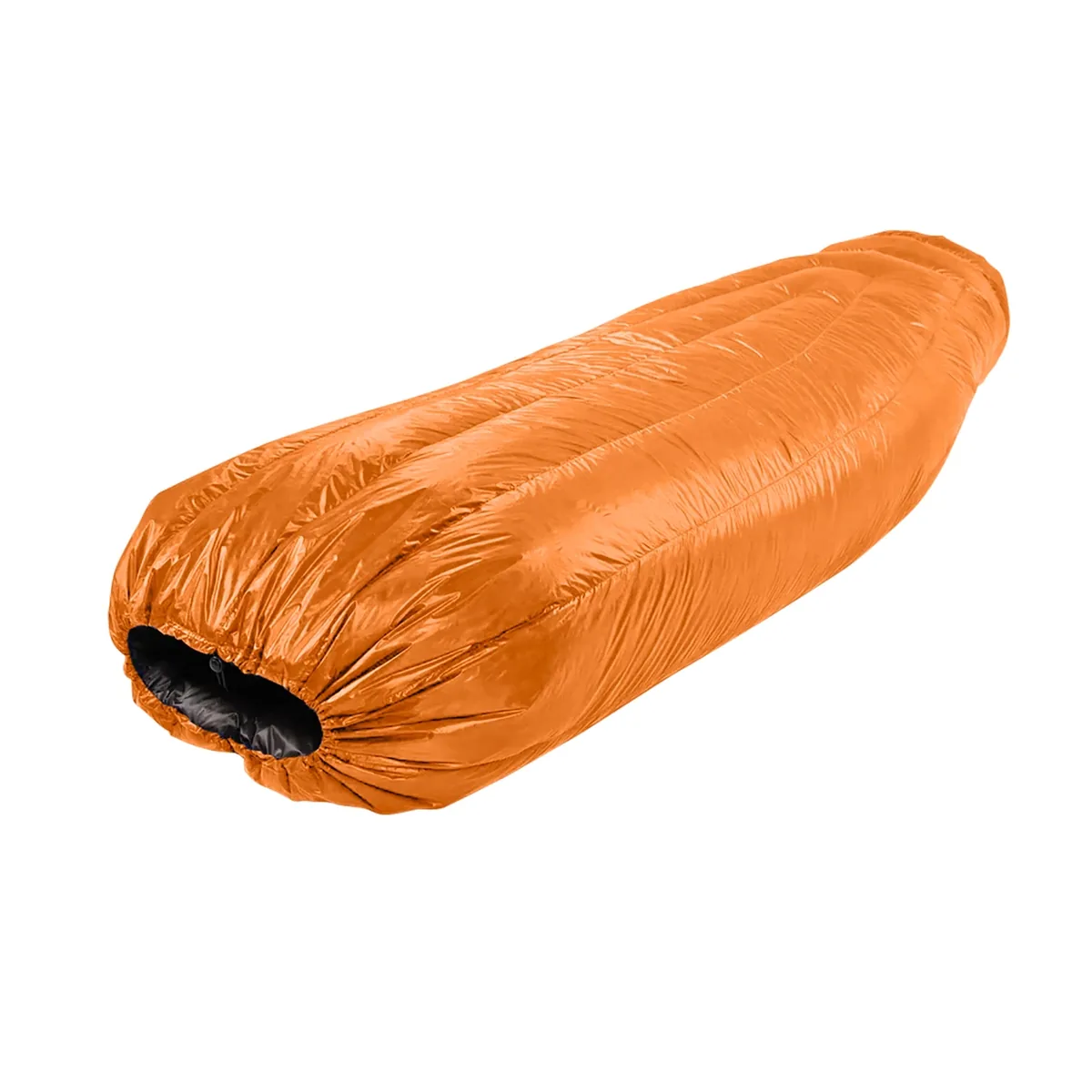
Enlightened Equipment
Enlightened Equipment Revelation 20
The quilt that made quilts mainstream in America. Enlightened Equipment builds every Revelation to order in Minnesota across five lengths, four widths, six temperature ratings, two fill powers and three shell deniers, which is thousands of combinations and the reason this entry lists one representative build rather than a size run. The Revelation's distinguishing feature against the otherwise-identical Enigma is a zippered and drawcord footbox that opens completely flat, so the same quilt covers a 20-degree night and a 60-degree one.
Best for: Buyers who want a quilt built to their own measurements
Full spec sheet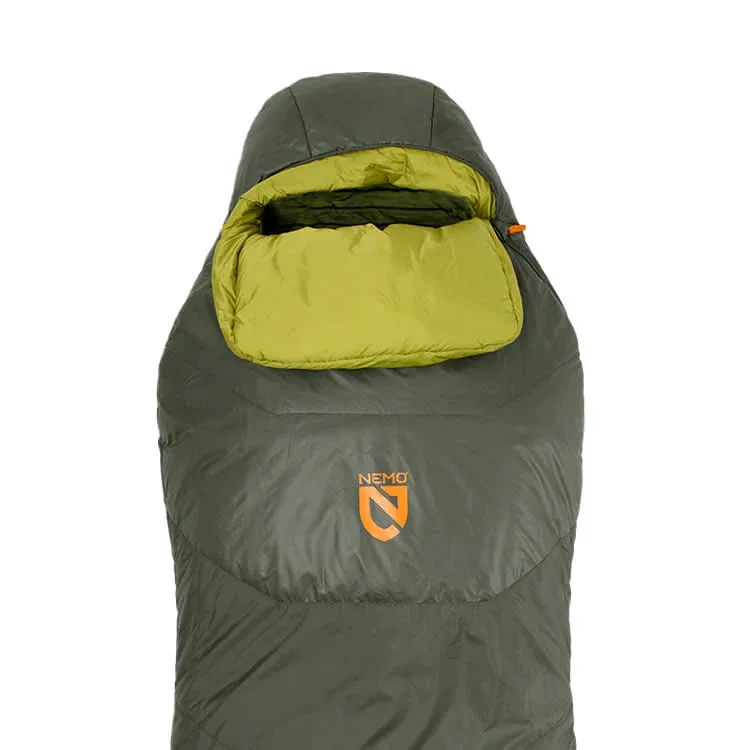
NEMO
NEMO Tempo 20
NEMO's entry synthetic bag: the Spoon shape and the Thermo Gills in a heavier 50-denier shell with a lower grade of Zerofiber, at $170. The 50D fabric is the real difference — it is a much tougher bag than the Forte, which matters more in a campground and on a car-camping trip than the 58-ounce weight does. Published ISO lower limit of 21 °F, honest for a bag with a 20 on the label.
Best for: Campground and car-camping trips in a wet climate
Full spec sheetREI Co-op
REI Co-op Magma 15
The Magma is the bag most people who compare specs end up buying, and the numbers explain why: 850-fill down, 23.3 ounces of it, an ISO comfort rating of 21 °F and an ISO lower limit of 9 °F, for $399. That is a genuinely six-degrees-warmer comfort figure than the 15 in the name, which is the opposite direction from almost every other bag in this catalogue — REI named the bag closer to its limit than its comfort and then published both, which is the honest way round.
Best for: Backpackers who want the best published numbers per dollar
Full spec sheet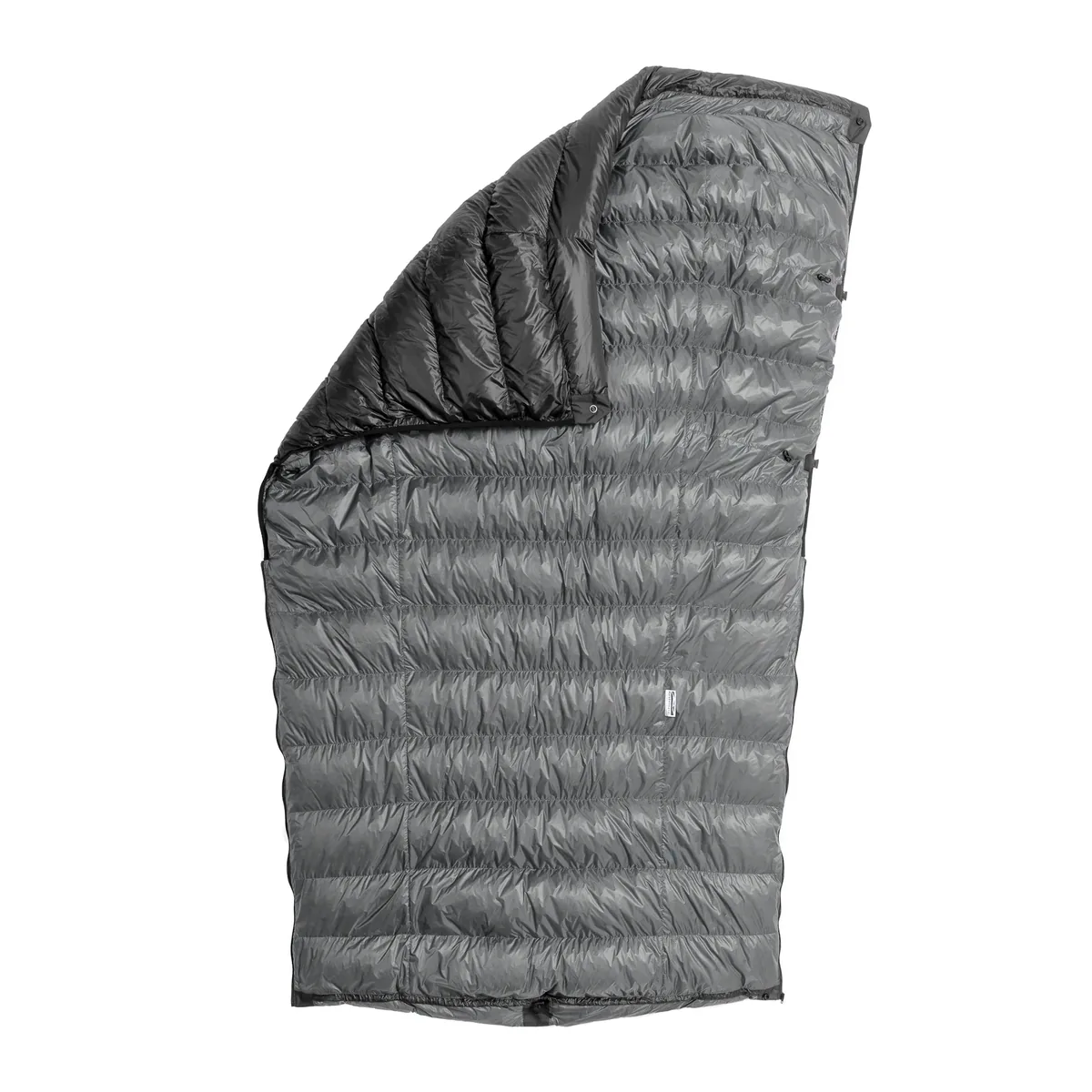
Katabatic Gear
Katabatic Flex 22 Quilt
Katabatic's pad-attachment system is the thing the rest of the quilt world copies, and the Flex is the model built around it: the quilt clips to two cords that run under the pad, and it can slide and roll with you while the edges stay sealed. That is the whole answer to the standard complaint about quilts. The Flex adds a zippered footbox to the formula so the same quilt opens flat into a blanket on a warm night, at the cost of an ounce or so over the sewn-footbox Alsek. Katabatic publishes single-side loft (2.75 inches here) and exact fill weights per size, but no lab rating.
Best for: Quilt sceptics — the attachment system is the reason to try one
Full spec sheet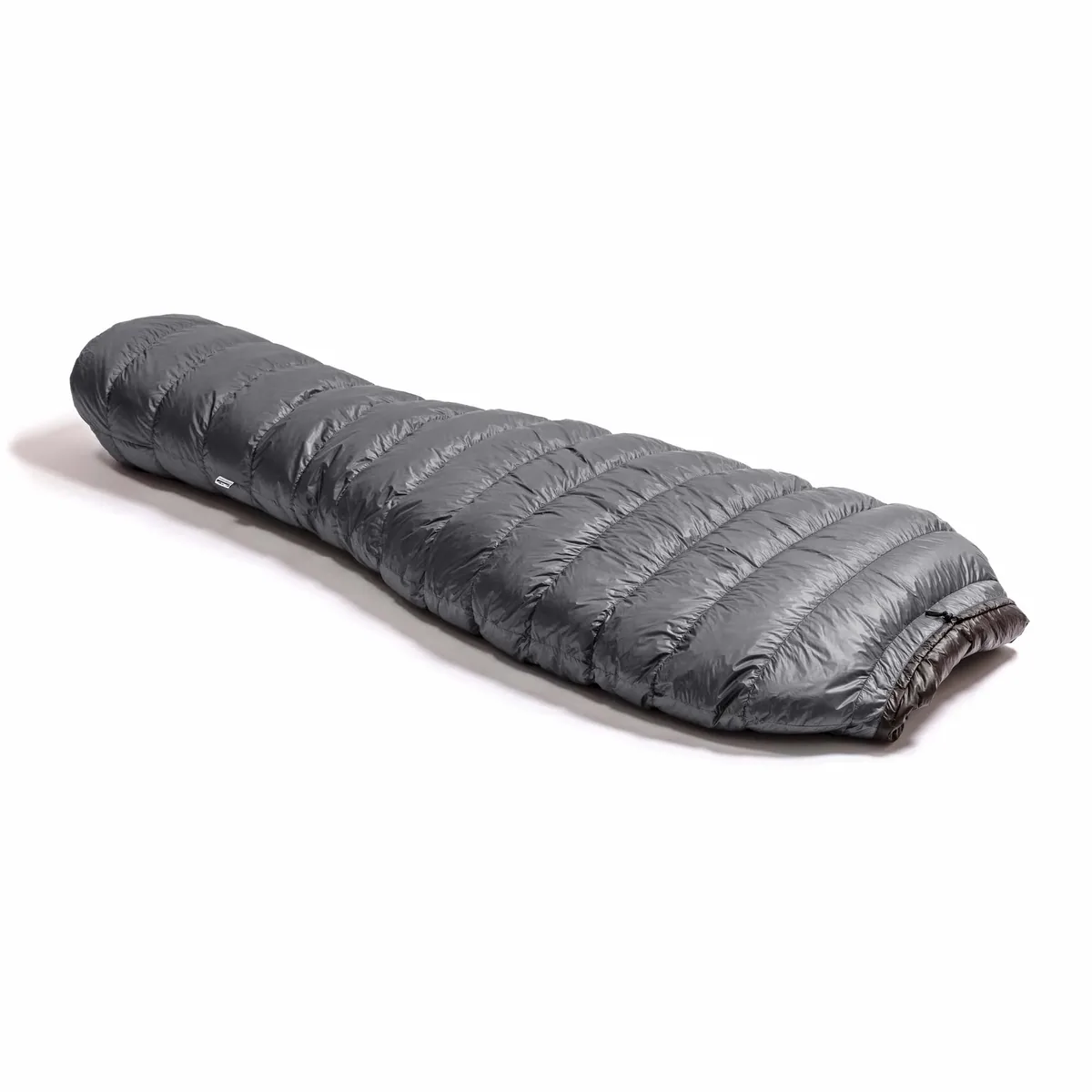
Katabatic Gear
Katabatic Alsek 22 Quilt
Same temperature and nearly the same fill as the Flex 22, with a sewn footbox instead of a zipped one. That saves about six-tenths of an ounce and a litre and a half of packed volume, and removes the only moving part on the quilt. If you have never wanted to open a quilt flat — and most people who own one never do — the Alsek is the better of the two.
Best for: Three-season backpacking where the quilt never needs to open flat
Full spec sheet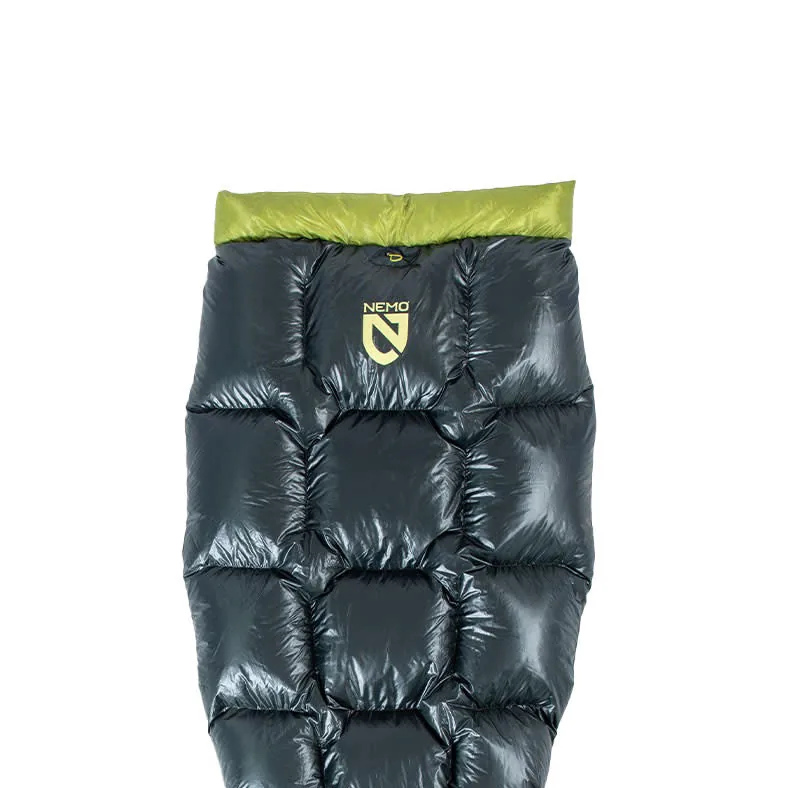
NEMO
NEMO Pulse Quilt
1000-fill down is the highest fill power available at any price, and the Pulse is the only item in this catalogue that uses it. The result is a 2.3-litre packed volume — smaller than a one-litre bottle and a bit — and 18 ounces for a quilt with a published ISO lower limit of 23 °F. It is also $550, which is the most expensive quilt here, and it is the only quilt in the catalogue with a lab figure attached. Whether 1000-fill is worth the money over 900 is the sort of question a spreadsheet answers better than a salesperson does; the honest answer is that the last hundred points of fill power buys about an ounce.
Best for: Thru-hikers optimising packed volume above everything
Full spec sheetA synthetic mummy with an ISO comfort rating of 24 °F for $189, built entirely from recycled fabric and fill. That comfort figure is the interesting part: at four degrees off its own name it is one of the most honestly labelled bags here, and it is warmer at the comfort end than several down bags costing three times as much. The price is three and a half pounds and a stuff sack the size of a football, which is why this is a car-camping and canoe-trip bag rather than a backpacking one.
Best for: Damp-weather camping on a budget
Full spec sheet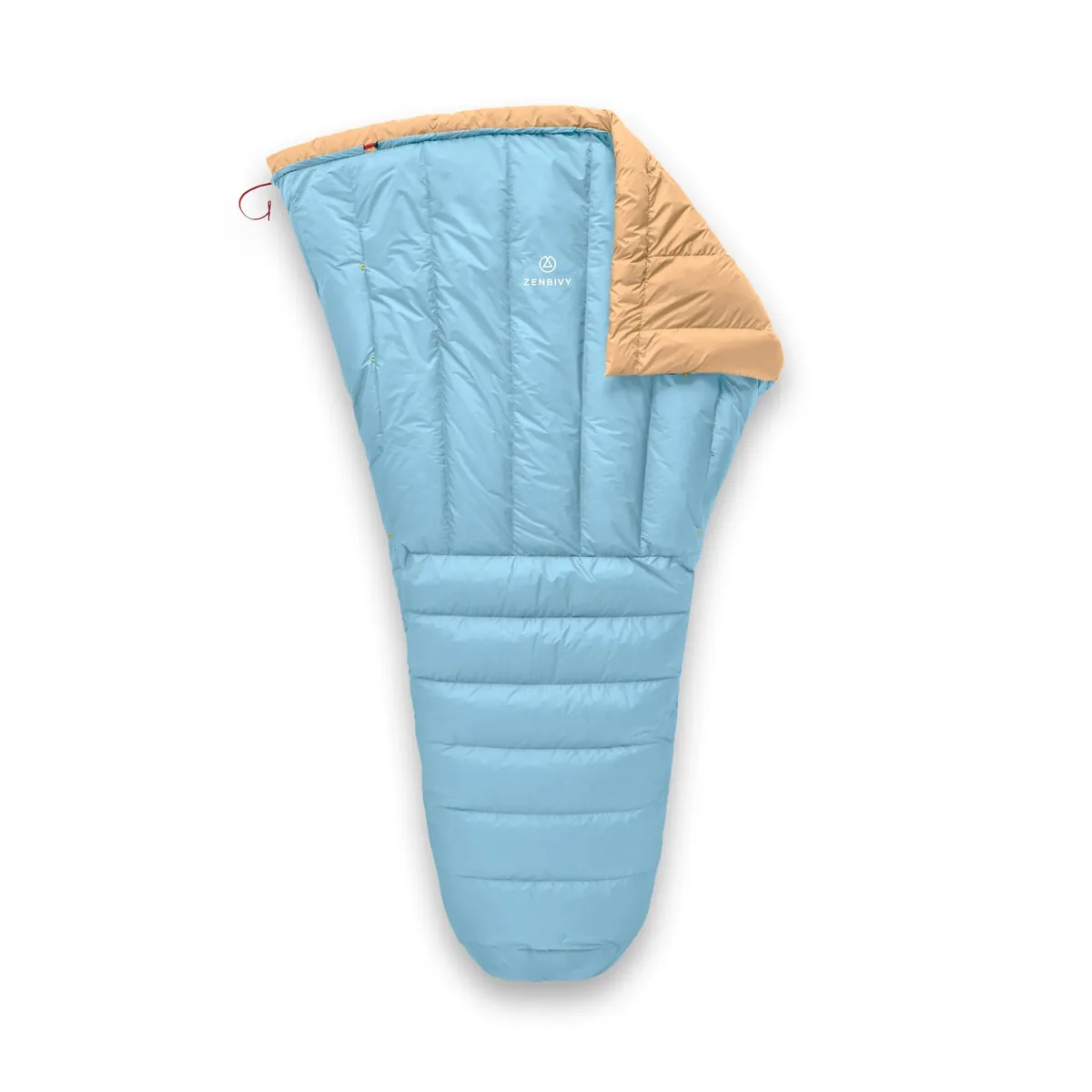
Zenbivy
Zenbivy Light Quilt 25
Zenbivy solved the quilt draft problem differently from everyone else: instead of strapping the quilt to the pad, the quilt clips to a fitted sheet that is already on the pad, so the seal moves with you and there is a hood-like head end built into the sheet. It is the most bed-like sleep system in this catalogue. Zenbivy publishes a limit-and-comfort pair of its own — 25 °F and 35 °F for this model — but does not claim ISO testing, so treat those as the maker's figures rather than lab ones.
Best for: Quilt users who have never got the drafts under control
Full spec sheet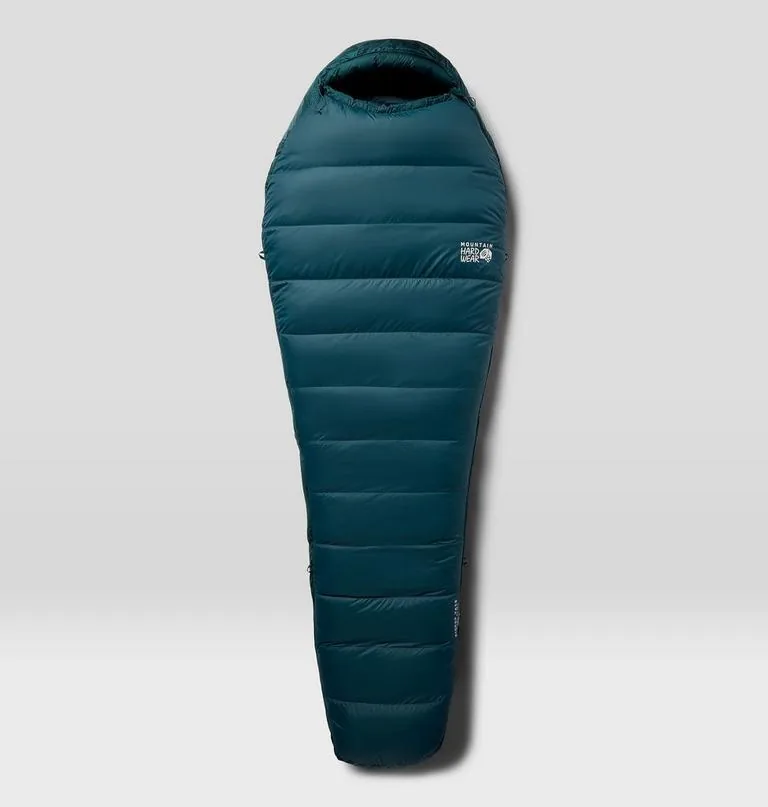
Mountain Hardwear
Mountain Hardwear Bishop Pass 15
A lot of down for the money: the Bishop Pass carries more fill than almost any bag at its price, at 650 fill power, and publishes an ISO comfort rating of 26 °F. Five and a half inches of measured loft in a 20-denier shell, with an expanded shoulder, hip and leg cut that Mountain Hardwear calls Performance Plus and most people would just call comfortable. At 37.4 ounces it is heavy for a 15-degree bag, and all of that weight is the low fill power buying loft through bulk.
Best for: Cold sleepers who want loft more than they want ounces
Full spec sheet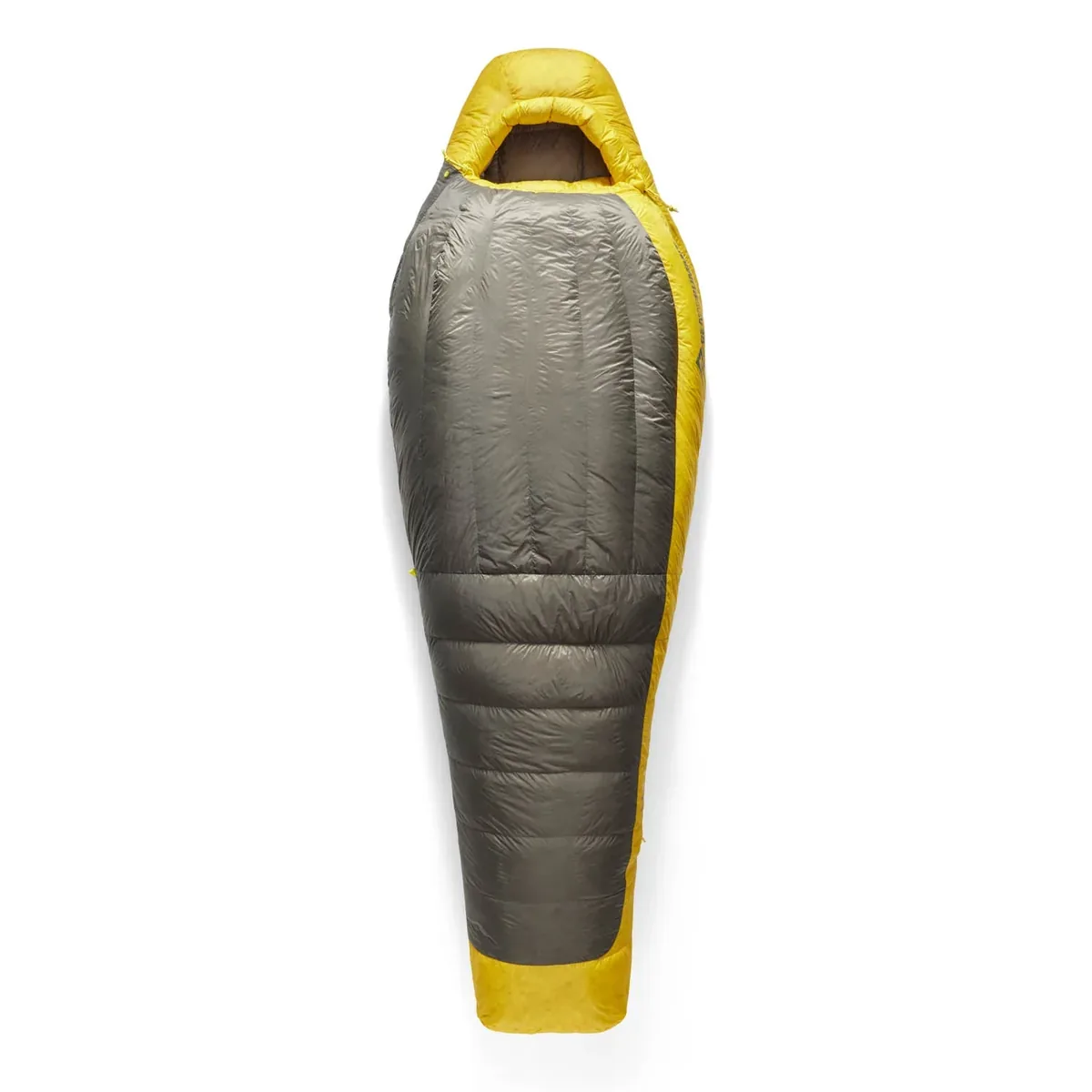
Sea to Summit
Sea to Summit Spark 15
Sea to Summit is one of the few brands that prints both ISO numbers next to each other, and the Spark 15 is the clearest illustration on this site of why that matters: the bag is sold as a 15, the lab limit is 16 °F, and the lab comfort figure is 28 °F. Twenty-eight is the number a cold sleeper should plan around, and it is thirteen degrees off the name. Everything else about the bag is excellent — 850-fill goose down, a 10-denier shell, a half-length zip to save weight, and 25.7 ounces total with nearly 17 ounces of that being down, which is one of the best fill-to-total ratios in the catalogue.
Best for: Backpackers who want the honest number before they buy
Full spec sheet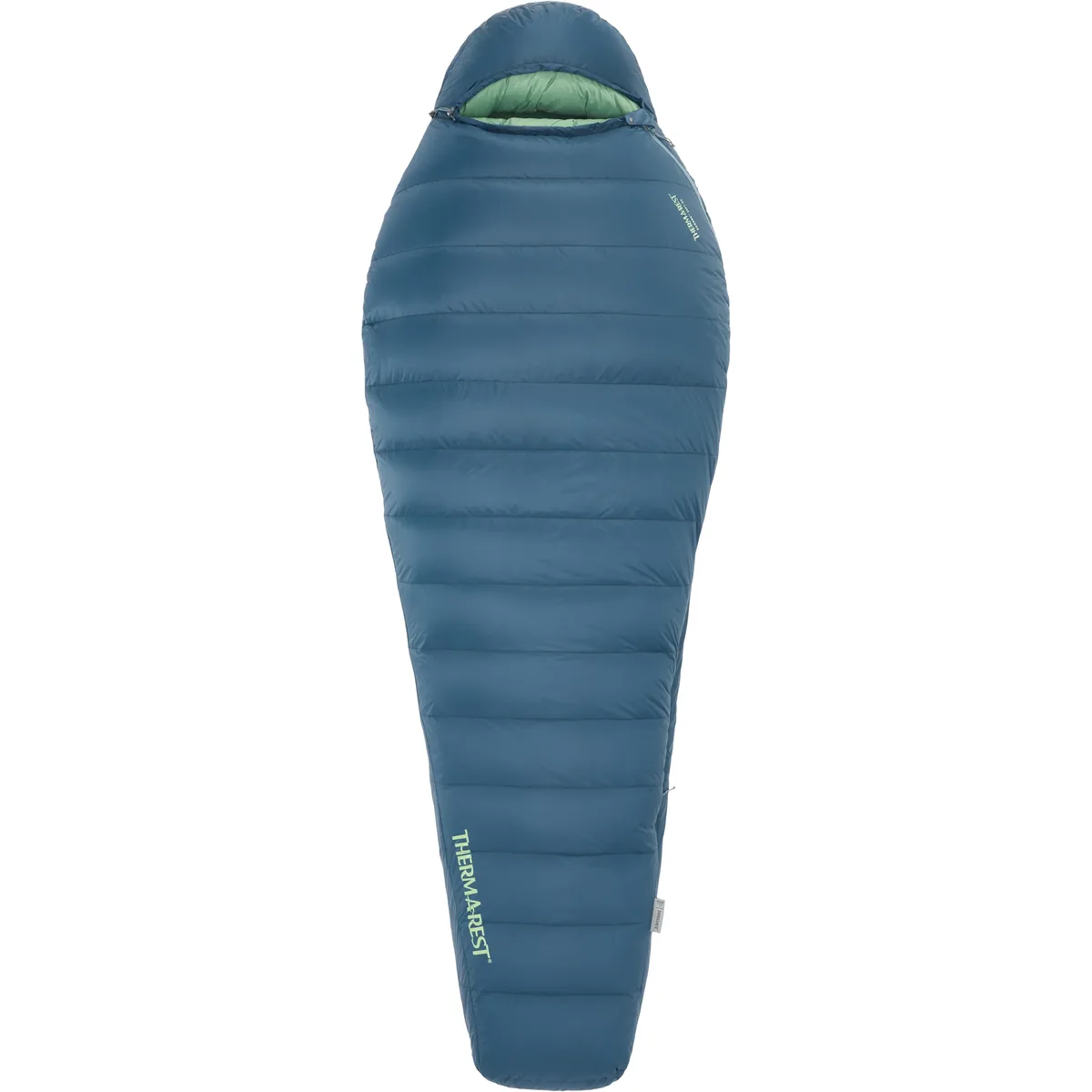
Therm-a-Rest
Therm-a-Rest Parsec 20
The Parsec is the lightest hooded mummy Therm-a-Rest makes, and the one entry here where the marketing number and the lab number sit only nine degrees apart — it is called a 20 and it tests to a 29 °F comfort figure and an 18 °F limit, which is about as close to truth-in-labelling as the 20-degree class gets. Seventeen ounces of 900-fill duck down inside a 20-denier recycled shell gets the whole bag to 29 ounces. The zoned baffles put more down on top and less underneath, on the correct theory that the down you lie on is doing nothing, and the shoulder girth is a generous 62 inches for a bag this light.
Best for: Three-season backpackers who want a hooded bag near quilt weight
Full spec sheetWhat people ask before the first cold night
Straight answers to the questions that come up again and again in backpacking and camping discussions.
What does a 20-degree sleeping bag actually mean?
Usually not that you will be comfortable at 20 °F. Under ISO 23537 a bag gets three numbers: a comfort rating, at which a cold sleeper is warm; a lower limit, at which a warm sleeper is curled up but not shivering; and an extreme figure that is a survival number and nothing more. Most makers name the bag after the limit. Across the bags here that publish both, the comfort rating sits several degrees above the name — sometimes thirteen degrees above it. Read the comfort figure and plan the trip around that. Comfort, limit and extreme, explained →
What R-value do I need for the temperature I camp in?
As a floor: about R 2 for a 40 °F night, R 3 for 30 °F, R 4 for 20 °F, R 5.5 for 10 °F and R 7 for freezing ground and snow. The pairing matters as much as the bag, because the insulation under your body is compressed flat and does nothing — the pad is the entire underside of the system. A 20-degree bag on an R-2 pad is not a 20-degree sleep system. The bag-to-pad pairing table →
Are R-values comparable between brands?
Since 2020, yes. ASTM F3340 gave the industry one test method and every serious maker now publishes a figure measured the same way, which is why R-values can honestly sit in one column. Before that each brand used its own method and the numbers were not comparable — so treat an R-value on an older pad, or on a pad whose maker doesn't name the standard, with suspicion. What R-value measures →
Quilt or sleeping bag?
A quilt deletes the hood and the crushed insulation under your back, which saves real weight — and hands you the job of sealing the edges. The people who get on with quilts are side sleepers who move, and the ones who don't are cold sleepers on narrow pads. The two things that decide it are the pad's width and the quilt's attachment system: a quilt that can float on its straps seals; one pinned flat against the pad does not. Quilts, drafts and attachment →
Down or synthetic?
Down gives more warmth per ounce and packs smaller; synthetic keeps insulating when it is wet and costs less. The dividing line is how likely your insulation is to get soaked and stay that way — a week of Appalachian spring rain is a synthetic trip, a dry alpine summer is a down trip. Hydrophobic down treatments narrow the gap but do not close it: treated down is slower to wet out, not immune. Down against synthetic →
Why is my sleeping pad so loud?
Most ultralight pads insulate with layers of aluminised film, and film crinkles when it flexes. The makers who have solved it either suspend the film inside the baffles instead of bonding it to the face fabric, or skip film altogether and use synthetic batting or down inside the chambers. Both approaches are represented in this catalogue, and both cost a little weight or a little money against a film pad of the same R-value. Pad types and what they sound like →
How much warmth does fill power buy?
None, directly. Fill power is cubic inches of loft per ounce of down — it says how efficiently the down turns weight into loft, not how much loft there is. Total warmth comes from fill weight times fill power, which this site shows as a loft budget. A bag with 20 ounces of 650-fill down is warmer than one with 14 ounces of 900-fill; it is just heavier and bulkier. 800 against 900 fill power →
Do I add a foam pad in winter, or buy a warmer one?
Stacked R-values add, which makes the foam pad the cheapest winter upgrade there is: an R-2 foam pad under an R-4.5 air pad gives you about R 6.5 for around $60 and fourteen ounces. It also takes the punctures. The case for a single winter pad is packed size — a foam pad rides on the outside of the pack and does not compress. Stacking two pads →
Why do some entries here have no star rating?
Because a rating only appears when a named non-Amazon retailer or the maker's own store publishes an owner-review average that can be pointed at. No score on this site is estimated, and Amazon's ratings are never republished here. Most of this catalogue sells through channels that publish no aggregate at all, so most entries show no stars — which is the honest outcome rather than a gap to be filled. How we compare →
How wide a sleeping pad do I need?
Twenty inches is the standard and it is narrow for anyone who sleeps on their side, because knees and elbows end up off the edge on cold ground. Twenty-two to twenty-five inches fixes it for a couple of ounces. It matters twice over with a quilt: a pad narrower than your shoulders lets the quilt's edges fall away and vent every time you turn over. Side sleeping, properly →