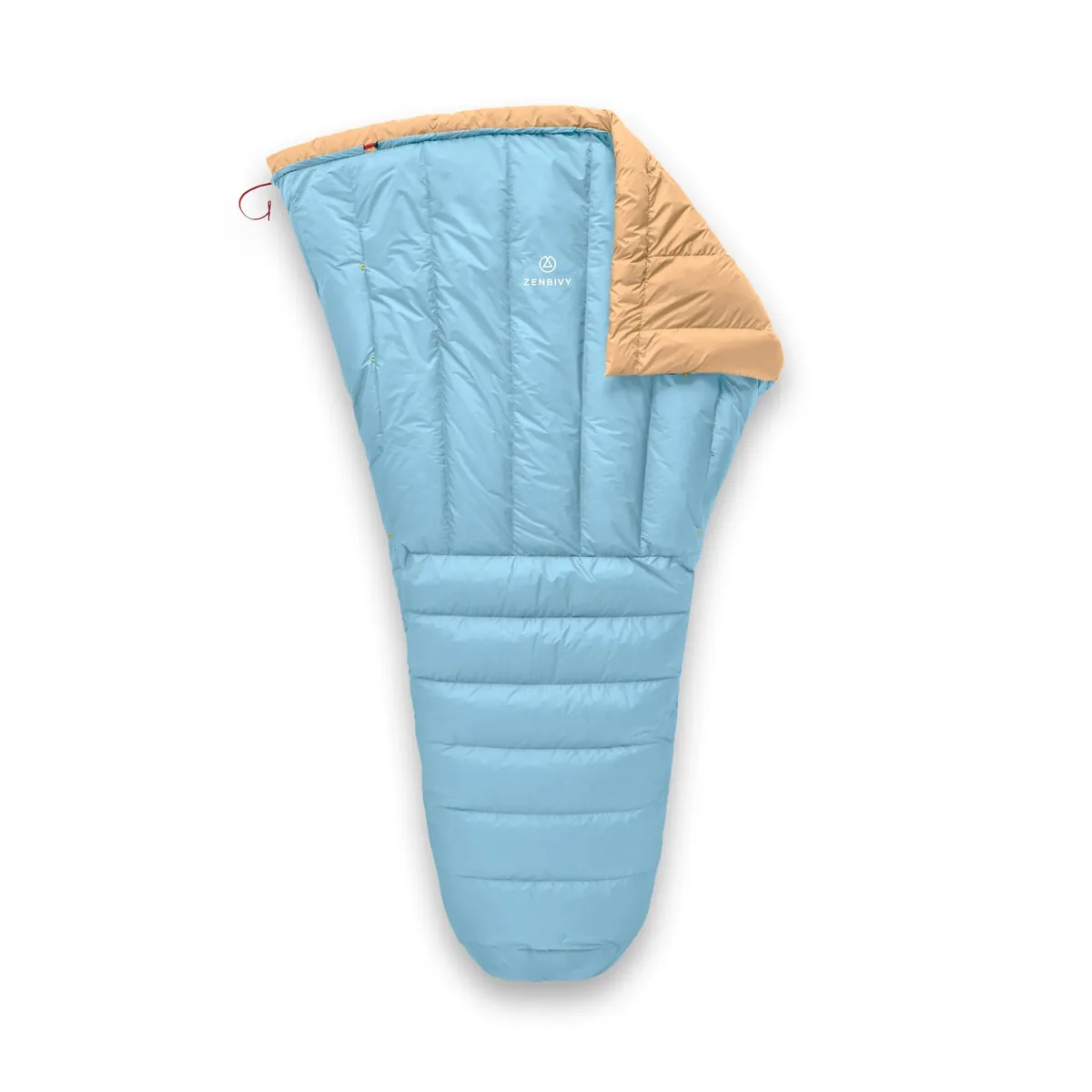
Zenbivy
Zenbivy Light Quilt 25
No citable owner-review average published for this one, so no stars.
Zenbivy solved the quilt draft problem differently from everyone else: instead of strapping the quilt to the pad, the quilt clips to a fitted sheet that is already on the pad, so the seal moves with you and there is a hood-like head end built into the sheet. It is the most bed-like sleep system in this catalogue. Zenbivy publishes a limit-and-comfort pair of its own — 25 °F and 35 °F for this model — but does not claim ISO testing, so treat those as the maker's figures rather than lab ones.
Label against lab
No ISO or EN rating is published for this one — the 25 °F is Zenbivy’s own figure, with no lab test behind it. Where a maker publishes loft or fill weight instead, those are the numbers worth comparing. What the standards measure
At that temperature the pairing table wants at least an R 4 pad underneath it.
Size run
One product, 3 sizes. The headline numbers on this page describe the Regular.
| Size | Weight | Approx. price | Length | Shoulder girth |
|---|---|---|---|---|
| Regular | 1 lb 6 oz | ~$289 | 72 in | 54 in |
| Large | 1 lb 9 oz | ~$309 | 80 in | 58 in |
| XL | 1 lb 12 oz | ~$329 | 84 in | 62 in |
Specifications
Highlights
Features
- Hydrophobic down
- RDS down
- Pad attachment straps
- Wide option
What it does well
- The sheet-and-clip system seals the quilt to a bed rather than to a pad, which is the most complete answer to quilt drafts here.
- 22 ounces with 11.3 ounces of 800-fill hydrophobic duck down.
- Zenbivy publishes its own limit and comfort pair (25 °F and 35 °F) rather than a single marketing number.
- Three sizes with published widths from 54 to 62 inches — generous for a quilt.
What it costs you
- The quilt needs a Zenbivy sheet to work as designed, so the real entry price is well above $289.
- The comfort and limit figures are Zenbivy's own; there is no ISO or EN testing behind them.
- A system this specific locks you into one brand's pads and sheets.
- At 22 ounces it is heavier than several 20-degree quilts here that carry no sheet.
Those two lists are drawn from Zenbivy’s published specifications and from reviews that measured them. They are not owner sentiment — anything owners said appears under its own heading below.
What owners say
Distilled from owner discussions and long-term published reviews, not from anything measured here.
Zenbivy provokes stronger disagreement than any other sleep system here, and the disagreement splits cleanly along what people are optimising for. Weight-focused owners recommend against it immediately and point at cottage quilts that weigh a third less for less money. Comfort-focused owners describe it as the thing that finally let them sleep properly outdoors.
The most interesting report is from someone who asked for advice, was steered away from Zenbivy toward a highly regarded cottage quilt, bought that instead, and says they wish they had bought the Zenbivy anyway. That is a rare kind of comment and it says something about how differently people weigh comfort against ounces.
On the design itself, the substantive criticism is structural: tying the closure system to the pad is where the concept is most fragile, and owners who think about it say so.
What owners like
- The people who own one tend to be strongly positive, and at least one owner who was talked out of buying it and bought a cottage quilt instead says they wish they had gone with the Zenbivy.
- The sheet-and-clip system is the thing owners buy it for, and it does solve the quilt draft problem more completely than straps do.
- It is the closest thing available to a bed rather than a bag, which is the specific appeal for people who dislike sleeping in a mummy.
- Owners describe it as the closest thing to a real bed they have found outdoors, which is exactly the thing the system sets out to be.
Common complaints
- Weight and price are the two criticisms, and they come up together and bluntly — owners describe Zenbivy kit as heavy and expensive relative to the alternatives.
- The system is the cost: a complete Zenbivy setup runs to a figure owners describe in thousands, not hundreds.
- Ultralight-focused owners recommend against it almost reflexively, and point at cottage quilts that weigh less for less money.
- Attaching the closure to the pad rather than to the quilt is criticised as the design's structural weak point.
Questions owners ask
Does the sheet system actually solve quilt drafts?
Why do ultralight backpackers recommend against it?
What does a full setup actually cost?
Do people who were talked out of it regret that?
Zenbivy Light Quilt 25, head to head
Others in the same band
More from Zenbivy →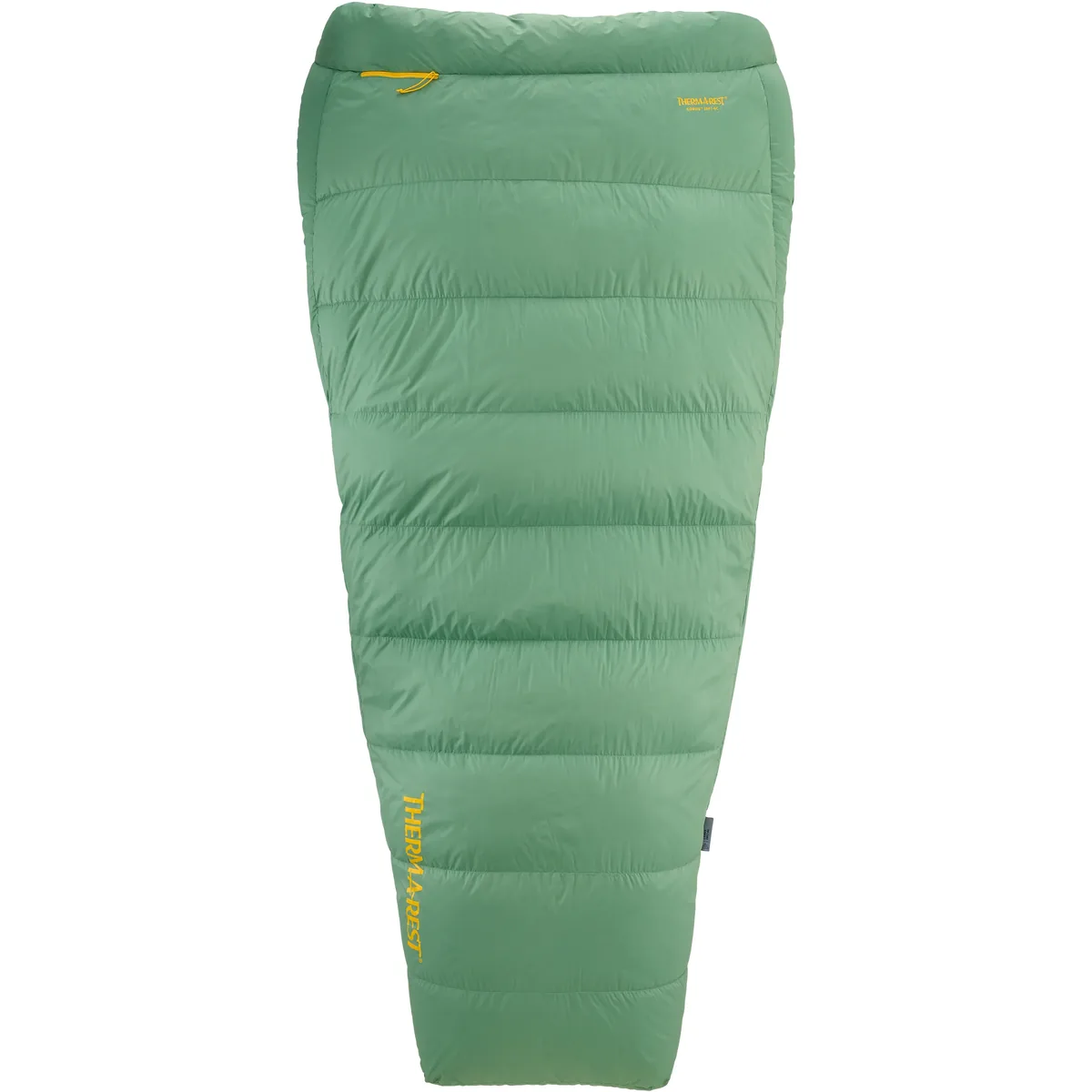
Therm-a-Rest
Therm-a-Rest Corus 20 Quilt
The Vesper's argument made in cheaper materials: same shape, same straps, same EN comfort rating of 32 °F, but 650-fill duck down inside a 20-denier shell instead of 900-fill goose down inside a 10. That costs seven ounces and saves $150, which for most weekend backpackers is the right side of the trade. The thicker shell is also more forgiving of the way quilts actually get used — dragged half-off the pad, sat on at breakfast, stuffed wet.
Best for: First-time quilt buyers who don't want to gamble $460
Full spec sheet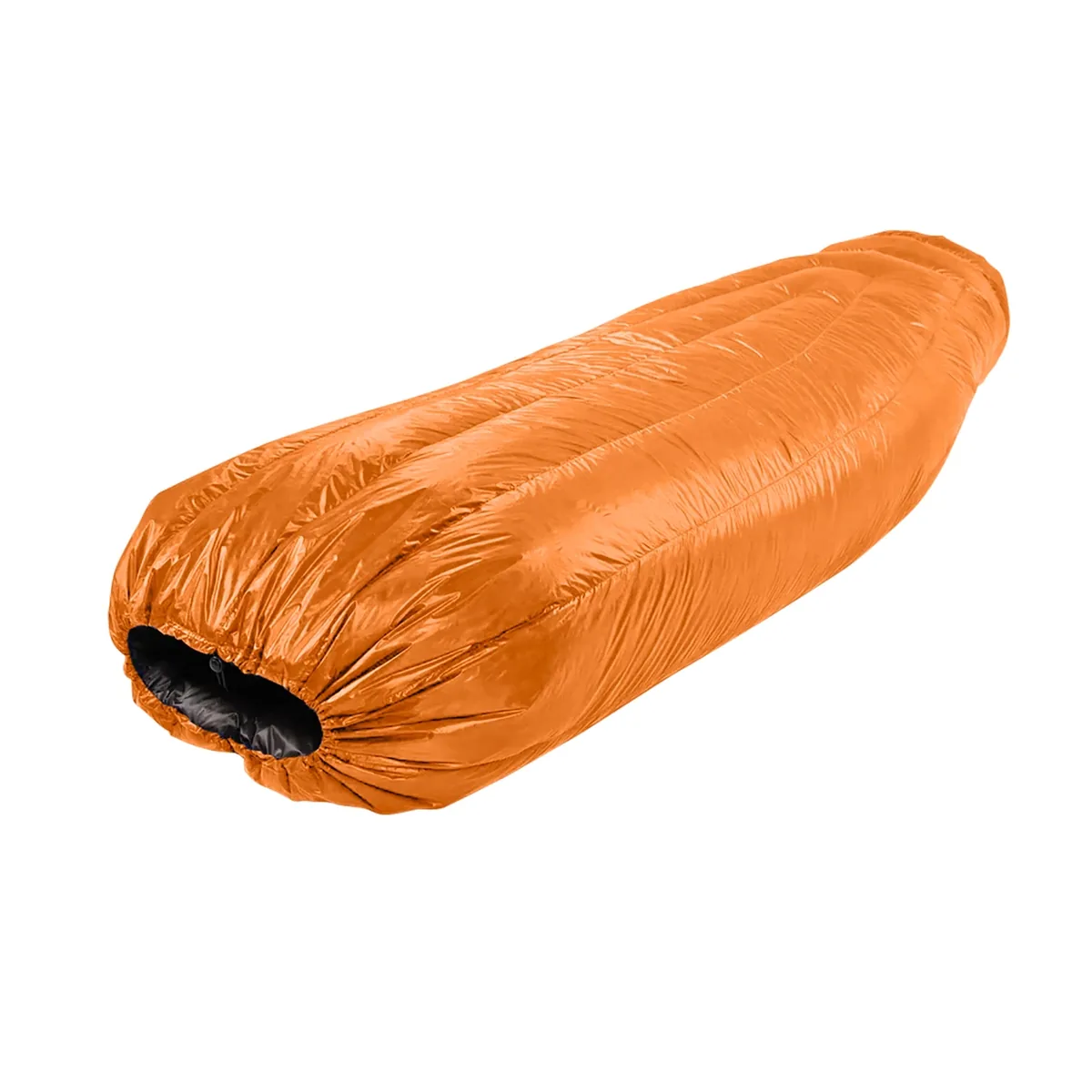
Enlightened Equipment
Enlightened Equipment Revelation 20
The quilt that made quilts mainstream in America. Enlightened Equipment builds every Revelation to order in Minnesota across five lengths, four widths, six temperature ratings, two fill powers and three shell deniers, which is thousands of combinations and the reason this entry lists one representative build rather than a size run. The Revelation's distinguishing feature against the otherwise-identical Enigma is a zippered and drawcord footbox that opens completely flat, so the same quilt covers a 20-degree night and a 60-degree one.
Best for: Buyers who want a quilt built to their own measurements
Full spec sheet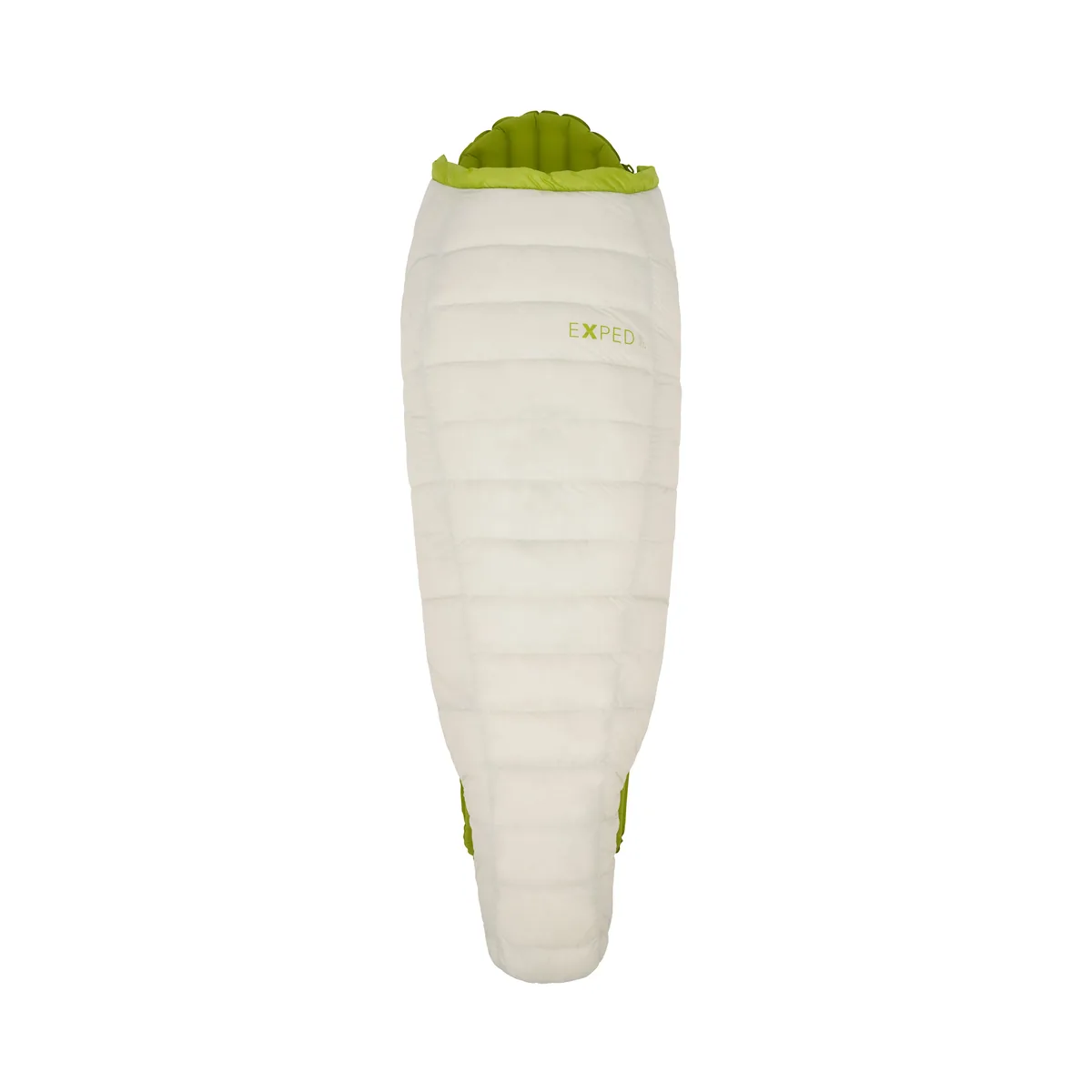
Exped
Exped Ultra Quilt 30
The quilt version of Exped's Ultra bag: 850-fill RDS Muscovy down, a recycled 10-denier shell, 18.5 ounces in the middle size, and — unlike the bag — no ISO figures at all, just a 32 °F number of Exped's own. That is worth knowing, because the hooded bag it shares a shell with tests to a 43 °F comfort rating, and a quilt is if anything harder to stay warm in. A 58-inch wrap width is generous by quilt standards and the three lengths cover most people.
Best for: Summer quilt use where a wide wrap matters more than a lab number
Full spec sheet